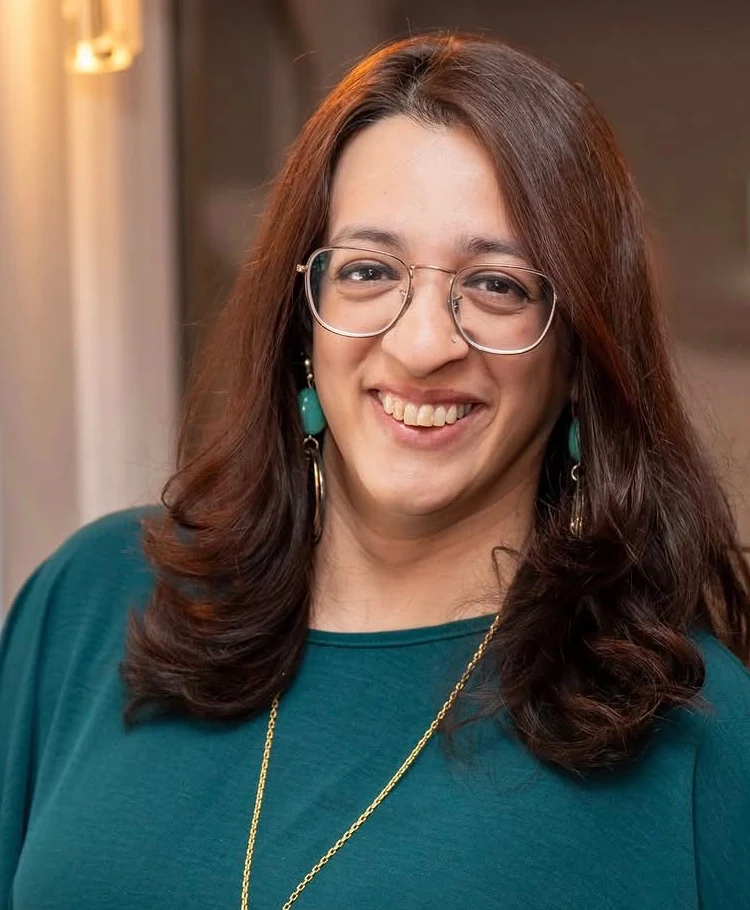
Asiya Dawood
Four miscarriages, then her daughter in 2020. Asiya broke her silence to start Asian Miscarriage Hub, so other South Asian families have somewhere to turn.
~ 4 min read
Asiya Dawood lost four babies before her daughter was born in 2020. In her community, she says, miscarriage is rarely spoken about. She chose to speak. She started Asian Miscarriage Hub and South Asian Baby Loss Awareness Week. Every quote on this page is in her own published words.
Asiya's story at a glance
- Journey: Four miscarriages, including late losses; then her daughter in 2020
- Founded: Asian Miscarriage Hub and South Asian Baby Loss Awareness Week (SABLAW)
- Volunteers: Sands South Asian Roundtable Group
- Speaks about: Baby loss, grief and faith in South Asian families
He was my son
Asiya married in 2007. Her first pregnancy ended at 18 weeks. It was the first of four losses. "I had another loss in 2009 at nine weeks and another at 23 weeks in 2016," she told Hyphen in 2025.
"I would think, 'I have been pregnant and I have had a baby. It's just that the baby is not here,'" she said.
"If you do not have that living baby with you, you are not classed as a mother, but I gave birth to a 23-week-old and he was my son."
We mustn't tell anyone
From the start, she was asked to stay quiet. "I was told, 'It's OK. You'll get over it and you'll get pregnant eventually, but we mustn't tell anyone,'" she said.
Then came the questions: "You've been married for 10 years now, why aren't you pregnant?"
"Miscarriage is a taboo topic. We just don't talk about it," she said. In 2025 she wrote: "In the South Asian community, we struggle to even say the word miscarriage, let alone speak openly about our grief."
Answers were slow to come. "I had to fight so hard to find what the cause was," she said. "I had to wait until I'd had three miscarriages until doctors would investigate. It's such a traumatic thing to put people through."
The child I never got to hold
Ramadan is the Muslim month of fasting. Eid al-Fitr is the celebration at its end. For years, both were hard.
"While others gathered for the joyous breaking of the fast, I felt a profound emptiness, longing for the child I never got to hold," she wrote.
"Eid was always triggering for me," she wrote. She watched her nieces and nephews "excitedly running around shouting Eid Mubarak", a greeting that means blessed Eid. "I would think about my babies and how my life could have been so different."
Her faith was shaken too. "You trust so much in the Almighty at that time and when it's snatched away from you, you do find that trust is broken," she said.
"You're trying to build that trust up again, but it doesn't happen overnight and it's not easy."
The Ramadan I had always dreamed of
In 2020, as the world went into lockdown, Asiya gave birth to her daughter. "It was happiness I had never felt before," she wrote.
"Even in lockdown, it was the Ramadan I had always dreamed of and wanted," she wrote. That Eid, "I made a huge meal and I celebrated myself for getting through the most difficult years of wanting and needing my child."
“She is my fifth child, but to many, she was seen as my first.”
She soon saw what was missing. She wrote that "while everyone saw the baby in my arms, no one acknowledged the four I had lost before her."
I knew something had to change
She started Asian Miscarriage Hub, an online support space on Instagram and Facebook. She set it up for women "who feel lost after baby loss", as a place "where they are not judged or questioned".
She has also volunteered with Sands, a baby loss charity. She joined its South Asian Roundtable Group, which helps shape its support for South Asian families.
"My photo is now on the Sands website, which might be a small thing, but it is so important for people to see people who look like them," she wrote.
"I knew something had to change," she wrote. Then she founded South Asian Baby Loss Awareness Week (SABLAW), with support from Sands and Tommy's, another pregnancy and baby loss charity.
In July 2026 it became a registered community interest company (CIC). Asiya is one of its directors.
She called it "a safe space for our community to speak, acknowledge, and begin to heal."
She is open about her faith. "I don't hide the fact that I'm a Muslim because it's important to point out that even if you do have faith, you are still allowed to grieve," she said.
Bold enough to speak
Her main aim, she says, is "to help women be bold enough to speak about their losses". She wants them "to speak about their babies, and to be beautiful in embracing their story."
She wrote this to parents facing Ramadan and Eid after loss. "There is no right or wrong way of healing or grieving during this time, the only thing that matters is you. Please do what is right for you."
Sources
- Asiya for Sands: Navigating Ramadan and Eid as a bereaved mother
- Asiya for Sands: Asiya's Impact, South Asian Heritage Month
- Hyphen: 'We just don't talk about miscarriage' (interview with Asiya)
- Asiya on Instagram: Meet the founder of South Asian Baby Loss Awareness Week
- Tommy's: South Asian Baby Loss Awareness Week
- Companies House: South Asian Baby Loss Awareness CIC
- Asian Miscarriage Hub on Instagram
This resonates:
Shared with the Appy + Yaar community.