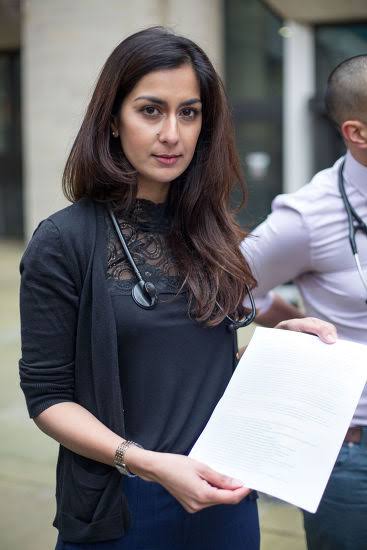
Dr Nadia Masood
The NHS was never an abstraction to Nadia. It carried her father through urgent open heart surgery and her mother through life saving cancer treatment, and both of them are still here because of it. So when she walked into that same system as a doctor, she was never going to be neutral about it.
She trained at St George's Hospital Medical School in London and became a Fellow of the Royal College of Anaesthetists. As a trainee anaesthetist in London she worked in intensive care, neonatal and paediatrics, holding the smallest lives at their most fragile.
Why anaesthesia leaves no room for error
An anaesthetised patient cannot tell you that something is wrong. They cannot flinch, or ask a question, or say they feel strange. Everything rests on somebody else noticing in time, every single time. That kind of vigilance does not switch off when the shift ends, and it is why she could not look at a rota built on exhausted people and quietly call it acceptable.
The year she took the government to court
In 2016 Nadia was one of five junior doctors who founded Justice for Health and took the government to the High Court, arguing that the new junior-doctor contract was unsafe and unlawful. They crowdfunded the case. Her evidence described exhausted staff and a rota that regularly did not have enough doctors on it. The story reached the front page of The Guardian and was raised in Parliament.
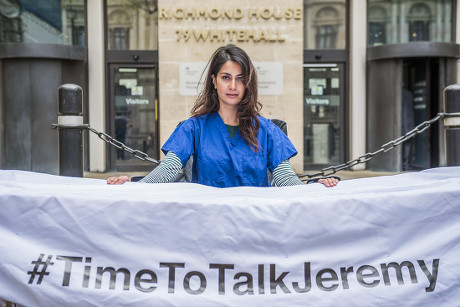
She did not wait for permission to say that something was unsafe.
What she put on the record was not comfortable. Clinical staff mentally and physically exhausted. A rota that regularly did not have enough doctors on it. She said it under her own name, in public, while still working as a doctor inside the very system she was challenging, and while everyone she worked alongside could read it.
A different way to practise medicine
After around two decades in clinical medicine she chose not to leave medicine, but to practise it differently. There was no obvious route from twenty years of anaesthesia into occupational medicine, so she built one, took the Diploma in Occupational Medicine, and then co-founded OccuMedExamPrep because the revision material she had needed was simply not good enough.
Now she works at Elsevier as an AI evaluation lead, on how artificial intelligence is assessed and governed in healthcare. It is the same question she was asking in 2016, pointed at something new: who is checking whether this is actually safe for the person on the other end of it.
She is also the mother of two daughters. She wants them to know that a South Asian woman can build a serious career on her own terms, and that it never has to compete with family.
At a glance
- Trained as
- Anaesthetist, and a Fellow of the Royal College of Anaesthetists
- Where
- Intensive care, neonatal and paediatrics as a trainee anaesthetist in London
- Known for
- Co-founding Justice for Health and taking the government to the High Court in 2016
- Now
- An AI evaluation lead at Elsevier, and co-founder of OccuMedExamPrep
This resonates:
Shared with the Appy + Yaar community.